
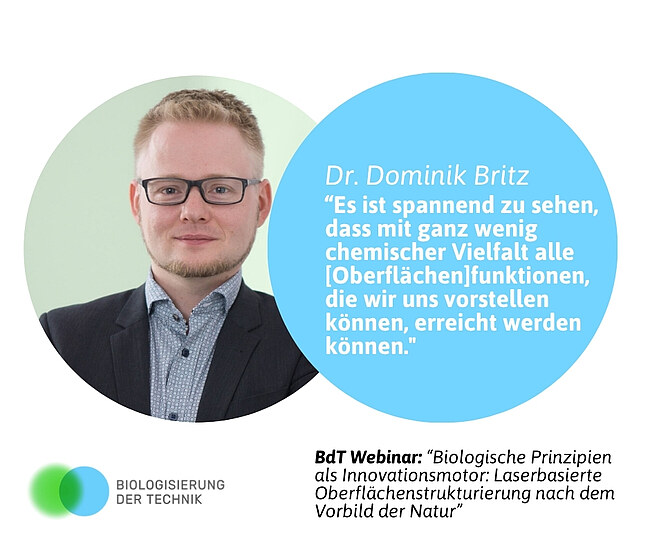
Surfaces play a central role in technology they are what we see, what we touch, and ultimately what determines the functionality of many products. The core question of the webinar on 17 October 2025, was therefore: How does nature achieve highly complex functions with minimal chemical diversity—and what can be learned from this for industrial surface structuring?
Dr.-Ing. Dominik Britz presented Direct Laser Interference Patterning (DLIP), a laser-based process that enables precisely this transfer. Pulsed laser beams are used to generate periodic micro- and nanostructures directly on the surface—without any additional substances. The technology employs constructive and destructive interference to create tailored topographies, leading to a wide range of functional properties: from enhanced connectivity in electrical contacts and improved friction and wear resistance to customized wettability and individualized, plagiarism-proof markings.
A key focus was the connection between DLIP and circular economy principles. By using less material and chemistry, and by “inscribing” functions directly into the surface, the technology reduces waste, emissions, and the consumption of critical resources typically associated with conventional chemical approaches. Especially in light of tightening regulatory requirements—such as the phase-out of PFAS and chromium—DLIP offers a future-proof alternative to traditional methods.
A striking example is the so-called Space Spoon, developed in collaboration with ESA astronaut Dr. Matthias Maurer and Villeroy & Boch. The laser-structured surface of this spoon reduces microbial adhesion by 80 %—a hygienic advantage not only in space.
Technologically, DLIP builds on developments from the founding universities of SurFunction GmbH and has been brought to industrial maturity through the use of nanosecond-pulsed laser radiation. The patented DLIP Elipsys® System allows variable pulse durations and wavelengths, is automatable and scalable, and achieves processing speeds of up to one square meter per minute. Current application fields include automotive, aerospace, electronics, and energy technology.
Beyond concrete applications, strategic scaling was also a key topic. Projects such as CLASCO, which focuses on climate-neutral, digitized laser structuring, and the integration of DLIP into robot-based large-area processing systems show that the process provides a wide range of possibilities for industrial use.
The webinar offered the 36 participants not only practical insights into a highly topical technology but also conveyed what is crucial for developing novel surfaces: the interplay of complementary processes and the targeted use of material intelligence for optical and functional characterization. It was an inspiring contribution to the question of how the biologization of technology can take shape—and the potential it holds.
Further upcoming dates in the webinar series can be found at biologisierung-der-technik.de.
12. November 2025, 3 pm | "Naturally inspired - technically implemented: Biologically inspired solutions for biomedical engineering" | Prof. Dr. Oliver Schwarz (Fraunhofer Institute for Manufacturing Engineering and Automation IPA) | LINK