

Arrival…
… by car
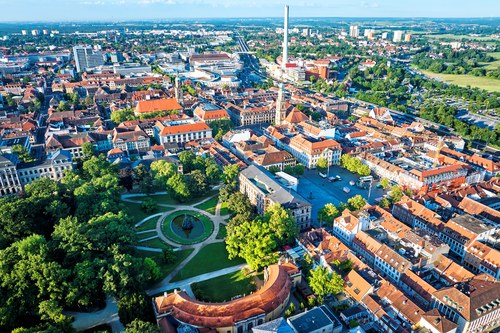
Erlangen is located in the heart of Franconia and is easily accessible via the A3 motorway (Frankfurt–Nuremberg) as well as the nearby A73 and A9. The Department of Materials Science and Engineering is situated in the south of Erlangen, close to the A73. Parking in the surrounding streets is limited and partly subject to fees. We recommend using designated public parking areas or nearby parking garages and allowing sufficient time to find a spot, especially on weekdays.
… by train and bus: Use the DB Event Ticket to book your journey!
Erlangen is well connected to the German rail network. Regular ICE, IC, and regional trains stop at Erlangen Hauptbahnhof, with direct connections to cities such as Munich, Nuremberg, Frankfurt, and Berlin. From the central station, bus line 287 takes you directly to “E-Techn. Fakultät”, which is only a short walk from the Department. Alternatively, taxis are available in front of the station, and depending on your preference, walking (approx. 25–30 minutes) is also possible.
… by long-distance bus or air
Several long-distance bus operators serve Erlangen, with stops near the central bus station (ZOB), located next to the railway station.
For air travel, Nuremberg Airport is the most convenient option, located about 20 km from Erlangen. From the airport, you can reach the conference venue by taxi in approximately 20 minutes, or by public transport via Nuremberg Hauptbahnhof and a short regional train ride to Erlangen. Frankfurt and Munich airports also offer direct long-distance train connections to Erlangen.
Entry Requirements and Travel Information for Germany
Citizens of the EU
For visitors from most countries, Germany requires a passport, which needs to be valid for at least 6 months. EU nationals do not require a visa to enter the Federal Republic of Germany.
Non-EU citizens
All Non-EU citizens require a visa. However, a visa is not required for visits of up to 90 days in an 180 day period for nationals of those countries for which the European Community has abolished the visa requirement.
You may apply for short stay visas (Schengen Visas) at missions of the German Federal Foreign Office, such as embassies and consulates.
Please also visit the homepage of “Auswärtiges Amt” to find a detailed table of all countries requiring a visa and more information on visa regulations, as well as a list of German missions around the world.
Invitation Letter
An invitation letter for the purpose of obtaining a travel visa or permission to attend the meeting will be handed out on request after registration for the symposium. For the invitation letter we need the following information of your passport:
- date of birth (day.month.year):
- nationality:
- passport number:
- expiry date of passport (day.month.year):
- place of birth (city, country):
If you need a letter of invitation in order to apply for a German visa, please contact the Congress Office vie e-mail to: cellmatdgm.de
After receipt of your passport details we will issue the invitation letter and send it to you by email.
Currency
As in most countries of the European Union, the official German currency is the Euro (€). Please note that there are no general bank hours in Germany. Most banks are open in the morning hours and just a few hours in the afternoon or early evening. Major credit cards are accepted at most cashpoints, stores, restaurants and hotels.
Telephone and Internet
Germany's international pre-dial is +49 (0049).
Public places like airports, universities, libraries, restaurants and cafés may offer "free"-WiFi Hotspots.
Electricity
The electrical power supply in Germany is 220v, 50 Hz, AC.Official plugs in Germany are:
- "Schukostecker" (round) Type F/ CEE 7/4
- "Eurostecker" (flat) Type C/ CEE 7/16
Time
Germany's standard time zone is UTC/GMT +1 hour.