
Systematically analyzing technical failure cases: DGM Academy training course
Technical failure cases often arise from the interaction of material condition, manufacturing, loading, and environmental conditions. A systematic failure analysis links these influencing factors with macroscopic and microscopic findings in order to reliably identify the causes of failure. The training course “Systematic Assessment of Technical Failure Cases” teaches key methods of fracture analysis, electron microscopy, and materials testing and applies them to concrete technical questions.

Technical failure can often not be attributed to a single cause. Material condition, manufacturing, design, mechanical and thermal loading, as well as environmental conditions can jointly determine whether and how a component is damaged. A sound failure analysis must bring these influences together and develop a reliable hypothesis about the cause based on the available findings.
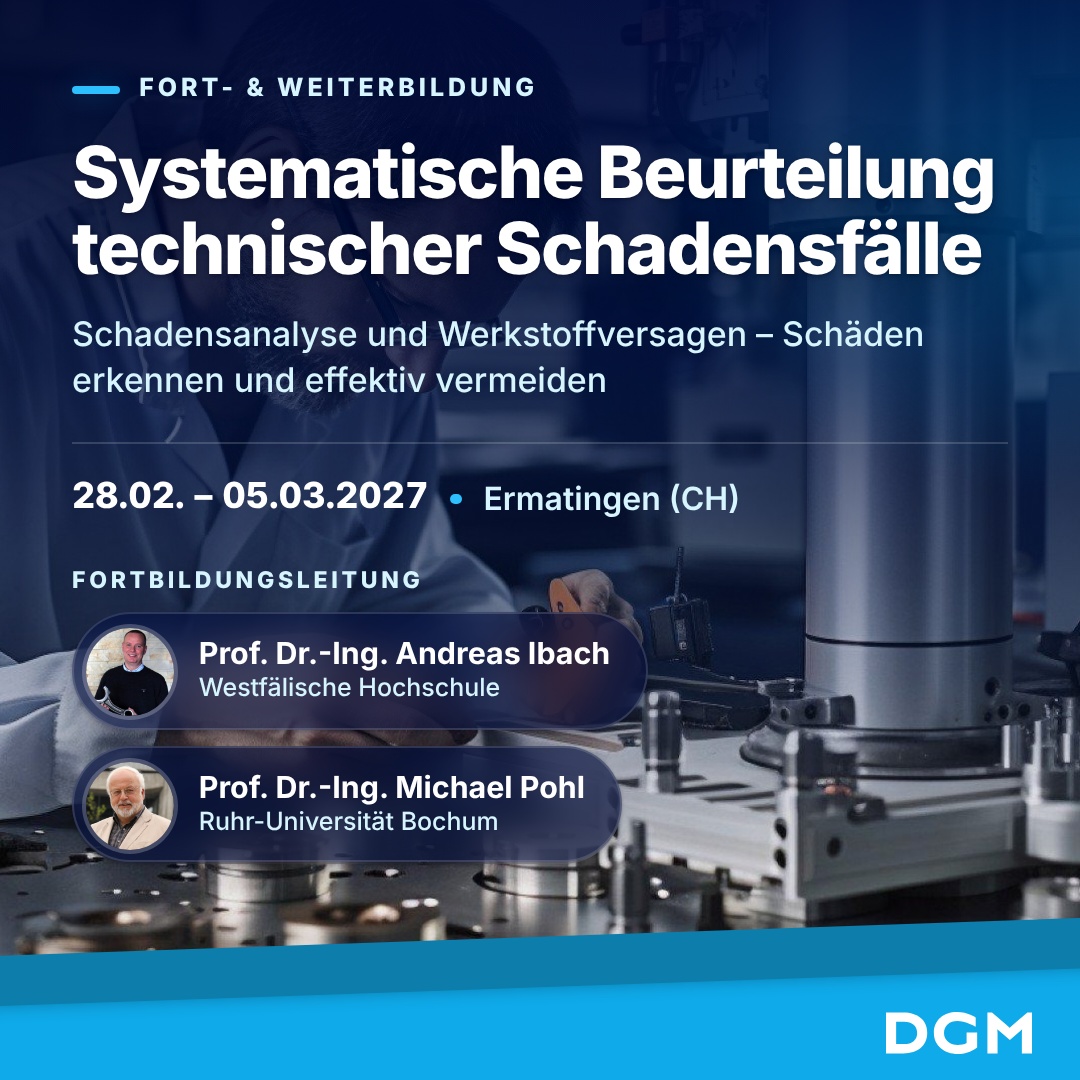
The training course “Systematic Assessment of Technical Failure Cases”, taking place from 28 February to 05 March 2027, addresses precisely these interrelationships. It views damaged components as technical carriers of information and teaches how macroscopic and microscopic findings, material properties, loads, and manufacturing conditions can be systematically linked with one another.
From damage pattern to cause
A damaged component contains information about the material, production, loading, and service conditions. The task of failure analysis is to evaluate this information in a structured way and reconstruct the sequence of failure from it.
One focus is on the macroscopic and microscopic appearances of typical failure cases. These include, among others, ductile overload fractures and fatigue fractures. Interpreting such fracture surfaces makes it possible to draw conclusions about the type and course of loading, but it must always be considered in connection with material condition, component geometry, and manufacturing.
Assess material, loading, and environment together
Technical damage can result from the interaction of different influencing factors. Mechanical loads and residual stresses play a role, as do temperature, corrosion, hydrogen, or material-specific characteristics.
A systematic failure analysis therefore does not consider these factors in isolation. Rather, the decisive question is which combination of influences is compatible with the observed findings. From this, measures can be derived for material selection, the manufacturing process, design, or operating conditions, enabling comparable damage to be avoided in the future.
Use analytical methods in a targeted way
Various materials science investigation methods are available for root cause analysis. Among other topics, the training course covers the use of electron microscopy as well as the fundamentals and developments of non-destructive materials testing.
Which method is suitable depends on the specific question at hand. It is often only the interplay of different investigations that makes it possible to reliably narrow down the extent of damage, mechanisms, and causes. Practical exercises apply these fundamentals to concrete failure cases and offer the opportunity to discuss participants’ own technical problems with experts.
Training course at a glance
Date: 28 February to 05 March 2027
Location: Ermatingen (Switzerland)
Language: German
Training course chair: Prof. Dr.-Ing. Andreas Ibach, Westfälische Hochschule, Prof. Dr.-Ing. Michael Pohl, Ruhr University Bochum
Further information on the program and participation is available on the DGM Academy website.