
Materials Analysis Meets AI: New Approaches to Materials Characterization
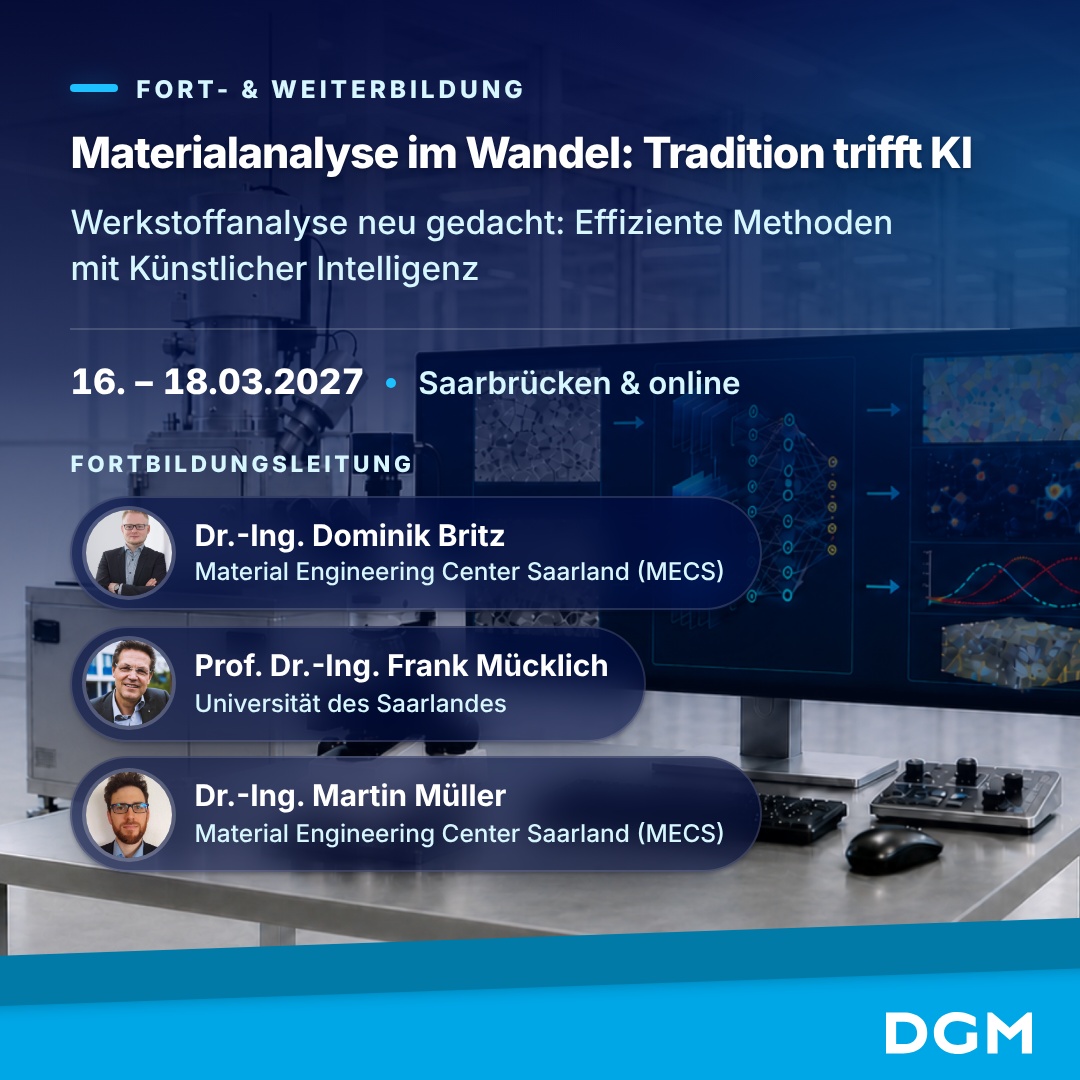
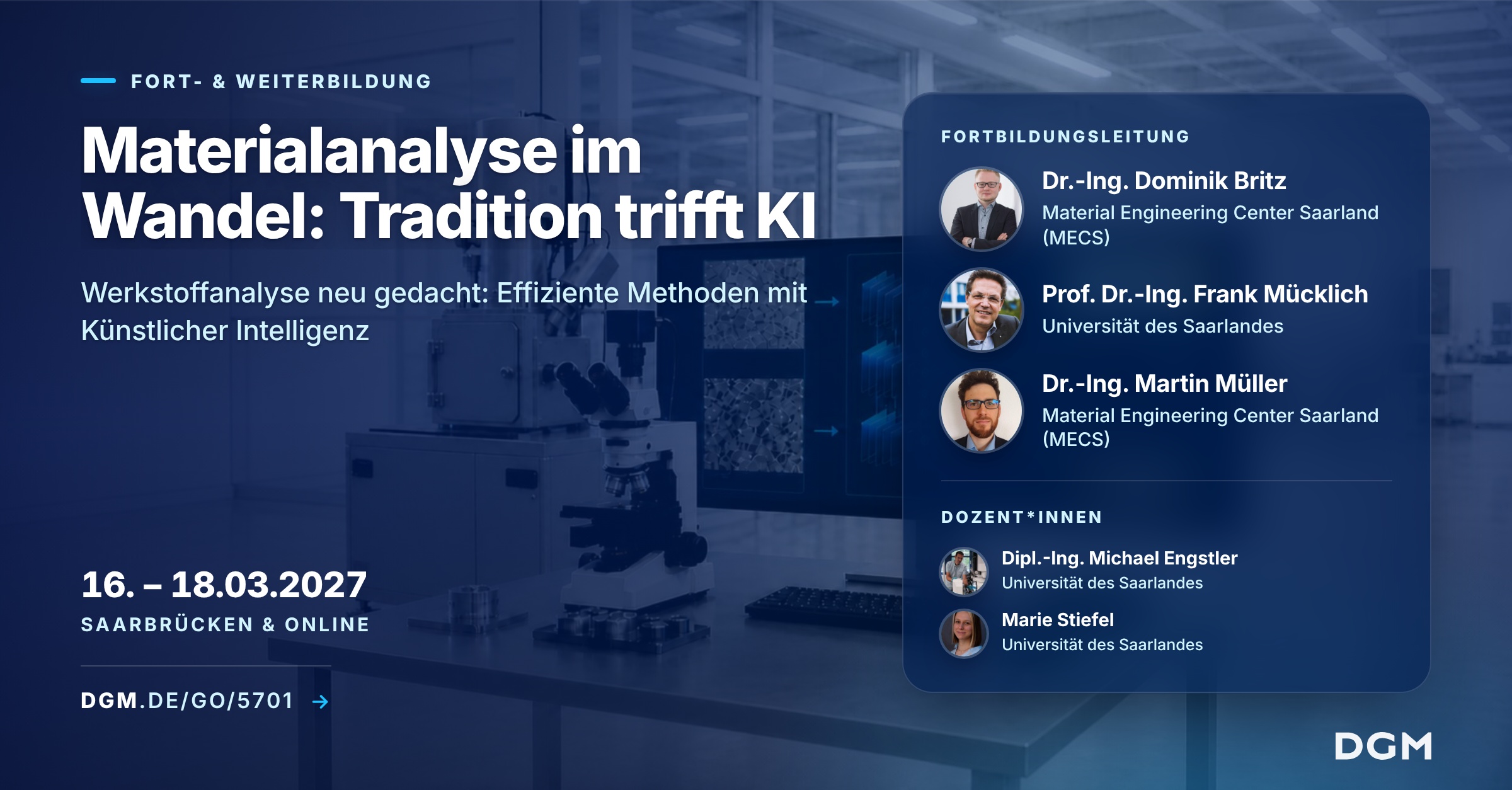
How can complex microstructures be reliably identified, quantified, and evaluated? And what advantages do artificial intelligence and deep learning offer over conventional analysis methods? The DGM training course “Materials Analysis in Transition: Tradition Meets AI,” taking place from 16 to 18 March 2027 in Saarbrücken and online, explores how established materials characterization techniques can be combined with modern digital analysis methods.
From Conventional Microstructural Analysis to AI-Assisted Evaluation
Accurate materials analysis is essential for understanding material properties, optimizing manufacturing processes, and ensuring component quality. Modern microscopy techniques provide increasingly detailed insights into microstructures. At the same time, the growing volume and complexity of image data create a greater demand for efficient and reproducible analysis methods.
Machine learning and deep learning offer new possibilities in this area. These technologies support tasks such as automated segmentation of microstructural constituents, classification of microstructural features, and quantitative analysis of large image datasets.
But when does the use of AI actually provide added value? Which tasks can already be reliably performed using conventional image processing? And what requirements must be met to ensure that AI-based results are scientifically valid and reproducible?
These questions are at the center of the DGM training course “Materials Analysis in Transition: Tradition Meets AI”, taking place from 16 to 18 March 2027.
Combining Microscopy, Image Processing, and Deep Learning
The three-day training course combines the fundamentals of materials characterization with advanced digital image analysis methods. It begins with established imaging techniques such as optical microscopy, scanning electron microscopy (SEM), energy-dispersive X-ray spectroscopy (EDX), electron backscatter diffraction (EBSD), and focused ion beam (FIB) techniques.
Another key focus is correlative microscopy. By combining different characterization techniques, researchers can integrate microstructural information and obtain a more comprehensive understanding of materials.
Building on these fundamentals, participants will explore various approaches to quantitative microstructural analysis. In addition to conventional segmentation techniques, the course introduces machine learning and deep learning methods for analyzing two- and three-dimensional materials data.
The underlying data infrastructure also plays an important role. Image databases, electronic laboratory notebooks, and appropriate hardware and software solutions provide the foundation for traceable, reproducible, and sustainable analysis workflows.
Hands-On Exercises with ImageJ/Fiji and AI-Based Methods
The practical sessions focus on applying the methods introduced throughout the course. Participants will work with sample datasets and explore different approaches to image registration and segmentation.
These exercises include the use of ImageJ/Fiji, a widely established, freely available software package for scientific image processing. Comparing conventional methods with machine learning and deep learning approaches will help participants better understand their respective strengths, limitations, and potential applications.
An important component of the course is the opportunity for direct technical exchange with the instructors. Participants are encouraged to bring their own questions and challenges from research, development, or industrial quality assurance and discuss potential solutions with the experts.
Expertise in Materials Science and Digital Materials Analysis
The course is led by Dr.-Ing. Dominik Britz and Dr.-Ing. Martin Müller from the Material Engineering Center Saarland (MECS), together with Prof. Dr.-Ing. Frank Mücklich from Saarland University.
The training is particularly relevant for specialists and managers working in materials science, materials engineering, research and development, and quality assurance who want to deepen their understanding of microstructural characterization and integrate AI-assisted analysis methods into their workflows.
Register Now for the DGM Training Course in March 2027
For professionals seeking to combine conventional materials analysis with AI-assisted image evaluation, the course provides a foundation in relevant methods, practical experience, and opportunities to discuss specific application challenges.
Further information about the program and registration is available here.