
Copper and Copper Alloys: Why Material Data Alone Is Not Enough for Proper Component Design
Selecting suitable copper materials requires more than comparing technical parameters. Microstructure, strengthening mechanisms, and surface condition have a significant influence on how a material will behave in its later application. Wrong decisions can lead to scrap, unnecessary material use, and higher production costs. The new DGM training course “Copper and Copper Alloys” on 21 and 22 April 2027 in Stuttgart provides engineers and experts from research and industry with the materials science fundamentals needed to better understand these relationships and take them into account in practice.
Why the material data sheet does not tell the whole story
Copper and copper alloys perform a wide range of functions in electrical engineering, energy technology, and industrial manufacturing. Their high electrical and thermal conductivity makes them attractive for numerous applications. At the same time, the materials used must meet requirements for strength, formability, corrosion resistance, and processability.
In industrial practice, materials are often selected on the basis of technical data sheets. These provide important parameters, but they do not reflect all the influences that are relevant to the behavior of a component under specific service conditions.
Microstructure plays an essential role. Grain size, dislocation density, and precipitates influence mechanical properties and can also affect electrical conductivity. The surface condition is also important, for example, for electrical contact connections.
This relationship becomes particularly clear in the strengthening of copper alloys. Strength can be increased through alloying elements, cold forming, or targeted heat treatments. Depending on the specific mechanism, however, this can be accompanied by changes in electrical conductivity. For materials development and component design, these conflicting objectives must therefore be considered systematically.
Where do costs, quality risks, and unnecessary material consumption arise?
Wrong decisions in material selection have a direct impact on production and on the later function of the component.
If an alloy is used whose properties are not sufficiently aligned with the actual requirements, processing problems, quality deviations, or scrap can result. Poor coordination between the material and the manufacturing process can also make additional processing steps necessary.
Another problem is the overdimensioning of components. If material properties are not sufficiently understood or existing strength potential is not used, this can lead to unnecessarily large material cross-sections. The consequences are higher material costs, greater resource use, and, where applicable, additional processing effort.
Especially for copper, demand for which is increasing due to applications in electrification and energy technology, needs-based material selection is becoming more important. Material efficiency therefore does not begin only with recycling, but already with alloy development, component design, and the choice of suitable manufacturing processes.
Understanding materials as the basis for better decisions
In day-to-day industrial operations, there is often little time to examine materials science relationships in detail. At the same time, developers and production managers must make decisions that have both technical and economic implications.
This is where the new DGM Academy training course “Copper and Copper Alloys: Understanding, Processing, and Applying Copper” comes in. It addresses the relationships between atomic structure, microstructure, and material properties and shows how these can be influenced through alloy development and process control.
In addition to the fundamentals of strengthening and the trade-off between conductivity and strength, various production and processing methods are considered. These include casting and forming processes, additive manufacturing, as well as welding and soldering processes. Surface engineering and the specific requirements of electrical connectors complete the program.
Laboratory tours and demonstrations in the areas of casting, rolling, and additive manufacturing enable participants to understand the relationships covered using practical processes. In addition, participants can discuss their own questions with experts.
The aim is not to view material properties in isolation, but to evaluate them in connection with manufacturing conditions and specific component requirements. This understanding supports more targeted material selection, the avoidance of typical processing errors, and more efficient material use.
Training course in Stuttgart: date and Scientific Chairs
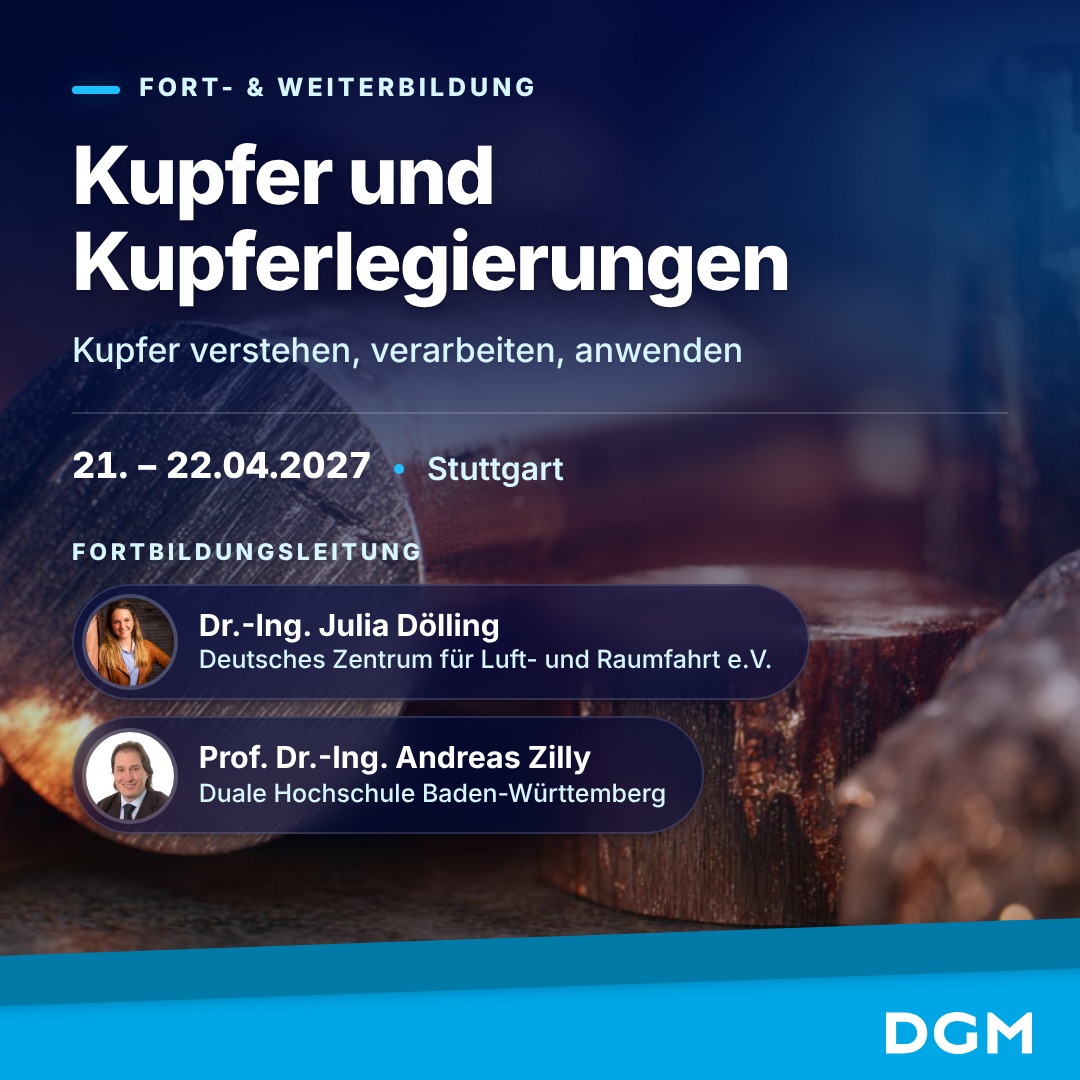
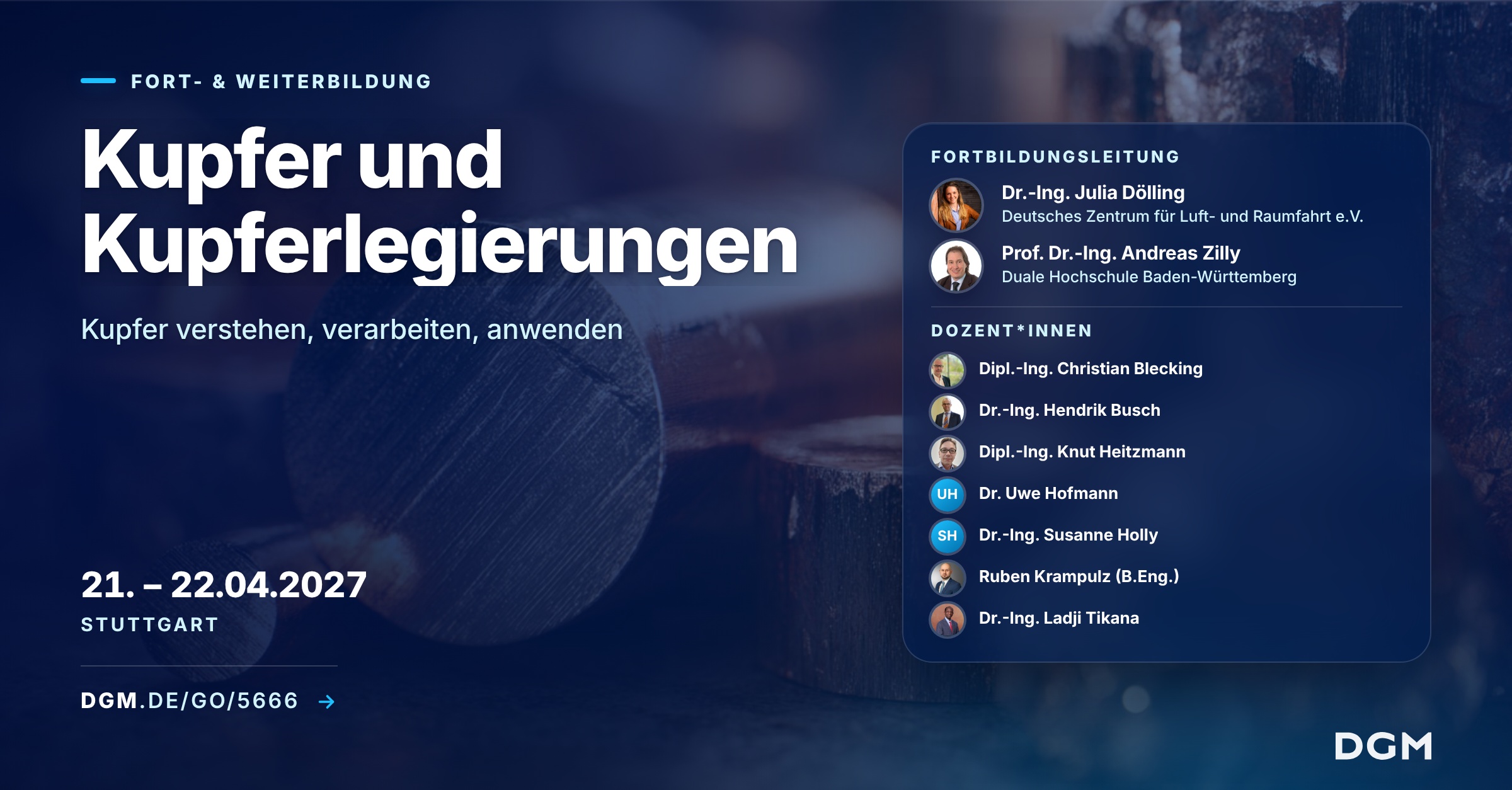
The DGM training course “Copper and Copper Alloys: Understanding, Processing, and Applying Copper” will take place on April 21 and 22, 2027 in Stuttgart.
The Scientific Chairs are Dr.-Ing. Julia Dölling from the German Aerospace Center (DLR) and Prof. Dr.-Ing. Andreas Zilly from the Baden-Wuerttemberg Cooperative State University (DHBW).
The event is aimed at engineers, developers, production managers, and experts from science and industry who want to select, process, and use copper materials in a targeted way.
Event information
- Date: 21 April 2027, 10:00 a.m., to 22 April 2027, 4:00 p.m.
- Venue: Stuttgart
- Language: German
- Certificate: after participation
- Organizer: DGM Academy