
Powder Metallurgy: Understanding Component Quality Along the Entire Process Chain
Powder-metallurgical processes enable the cost-effective production of precise components and the development of materials with specifically tailored properties. The coordination of powder production, forming, and thermal treatment is crucial, as even minor process deviations can affect the microstructure and component quality. The “Powder Metallurgy” training course offered by the German Society for Materials Science (DGM) provides the scientific fundamentals and industrial applications of these manufacturing technologies. From 27 to 29 April 2027 in Dresden, the focus will be on established manufacturing processes, powder-based additive manufacturing, and the systematic assessment of process and material parameters.
From Powder Quality to Component Properties
The properties of powder-metallurgical components are significantly influenced as early as the production and selection of the starting powders. Particle size distribution, particle shape, and flow behavior determine, among other factors, how reliably powders can be dosed, shaped, and compacted. During subsequent sintering, temperature, atmosphere, and diffusion processes influence densification, microstructural development, and mechanical properties.
A key challenge is not to view these process steps in isolation. Unsuitable powders or insufficiently coordinated process parameters can lead to density differences, porosity, distortion, or crack formation. Such deviations are often only detected in the finished component and result in additional testing effort, rework, or scrap.
For industrial production, a fundamental understanding of the entire process chain is therefore required. It makes it possible to identify causes of defects at an early stage, adjust manufacturing parameters in a targeted manner, and improve the reproducibility of component properties.
Established Processes and New Manufacturing Opportunities
Powder metallurgy comprises various manufacturing technologies whose suitability depends on component geometry, material, production volume, and required properties.
The “Powder Metallurgy” training course covers, among other topics, die pressing, metal injection molding (MIM), hot isostatic pressing (HIP), and sinter-based additive manufacturing processes. The focus is not only on the respective process principles, but also on their technical limits and economically viable applications.
Another focus is on powder-metallurgical materials and products. These include hardmetals, tool steels, diamond materials, aluminum, titanium carbide composite materials, and hard magnets. The examples illustrate how specific microstructures and performance properties can be achieved through the targeted selection of starting materials and process conditions.
Process Understanding for Industrial Application
In operational practice, decisions about powder quality, manufacturing processes, and process control influence both component properties and the use of materials and energy.
The training course therefore provides knowledge for evaluating different manufacturing routes in terms of their technical possibilities and limitations. The focus is on issues of process optimization, quality assurance, and cost-effective production. The integration of new powder-based technologies into existing industrial manufacturing processes is also addressed.
Training Course in Dresden: Scientific Fundamentals and Industrial Perspectives
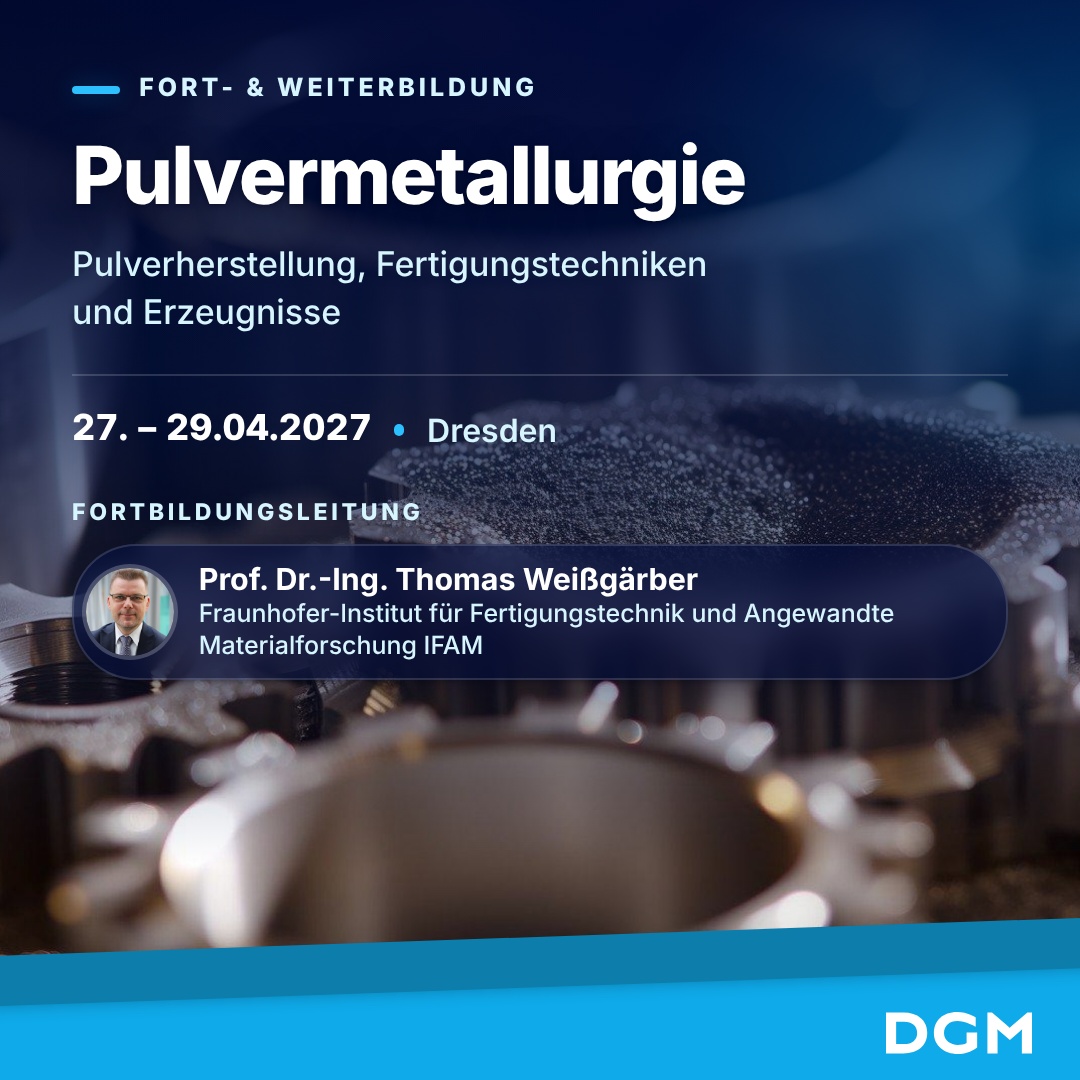
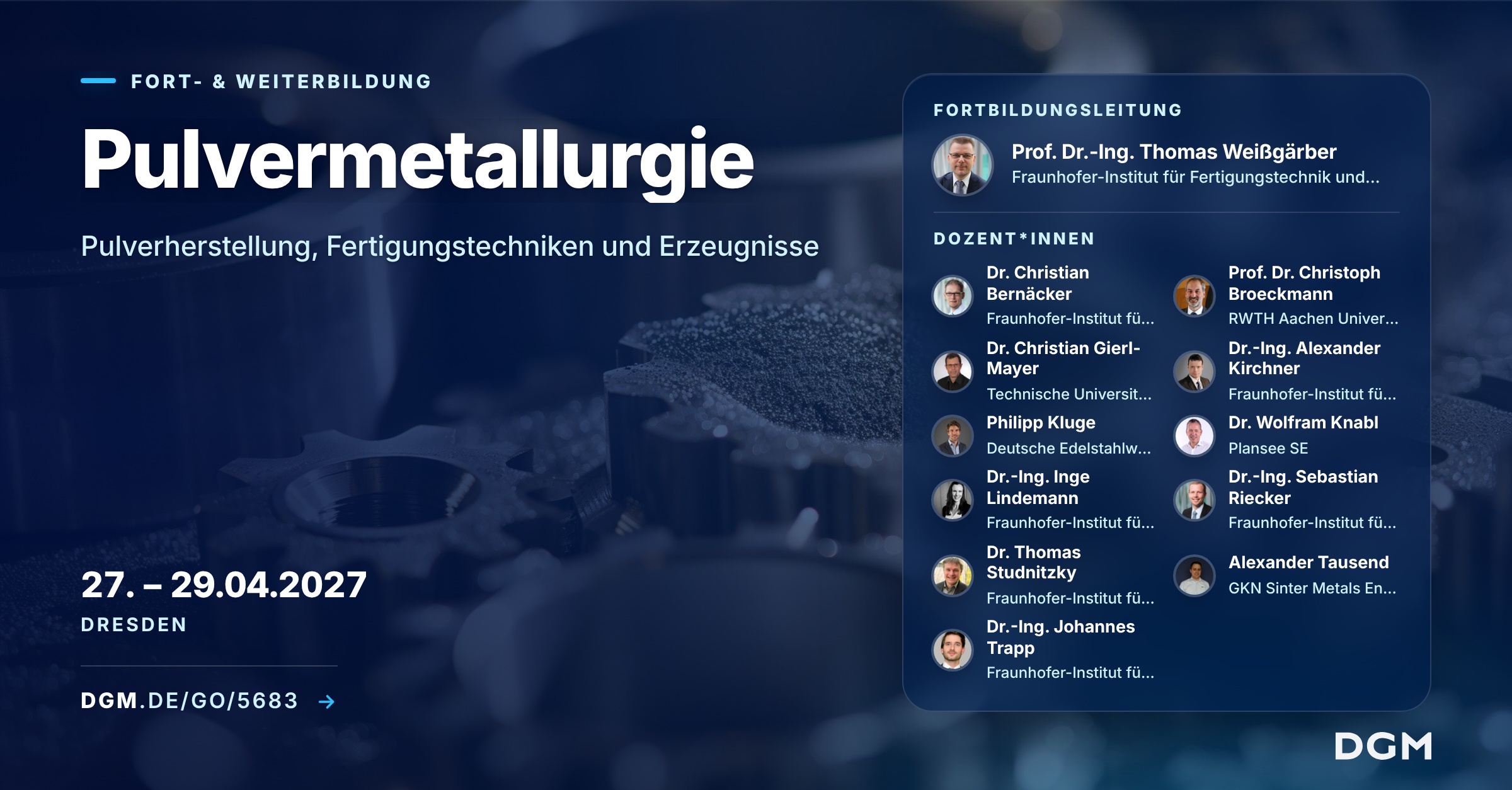
- Date: 27 to 29 April 2027
- Venue: Dresden
- Chair: Prof. Dr.-Ing. Thomas Weißgärber, Fraunhofer IFAM
- Focus areas: powder production and characterization, forming, sintering technologies, additive manufacturing processes, and powder-metallurgical materials
- Organizer: DGM Academy