
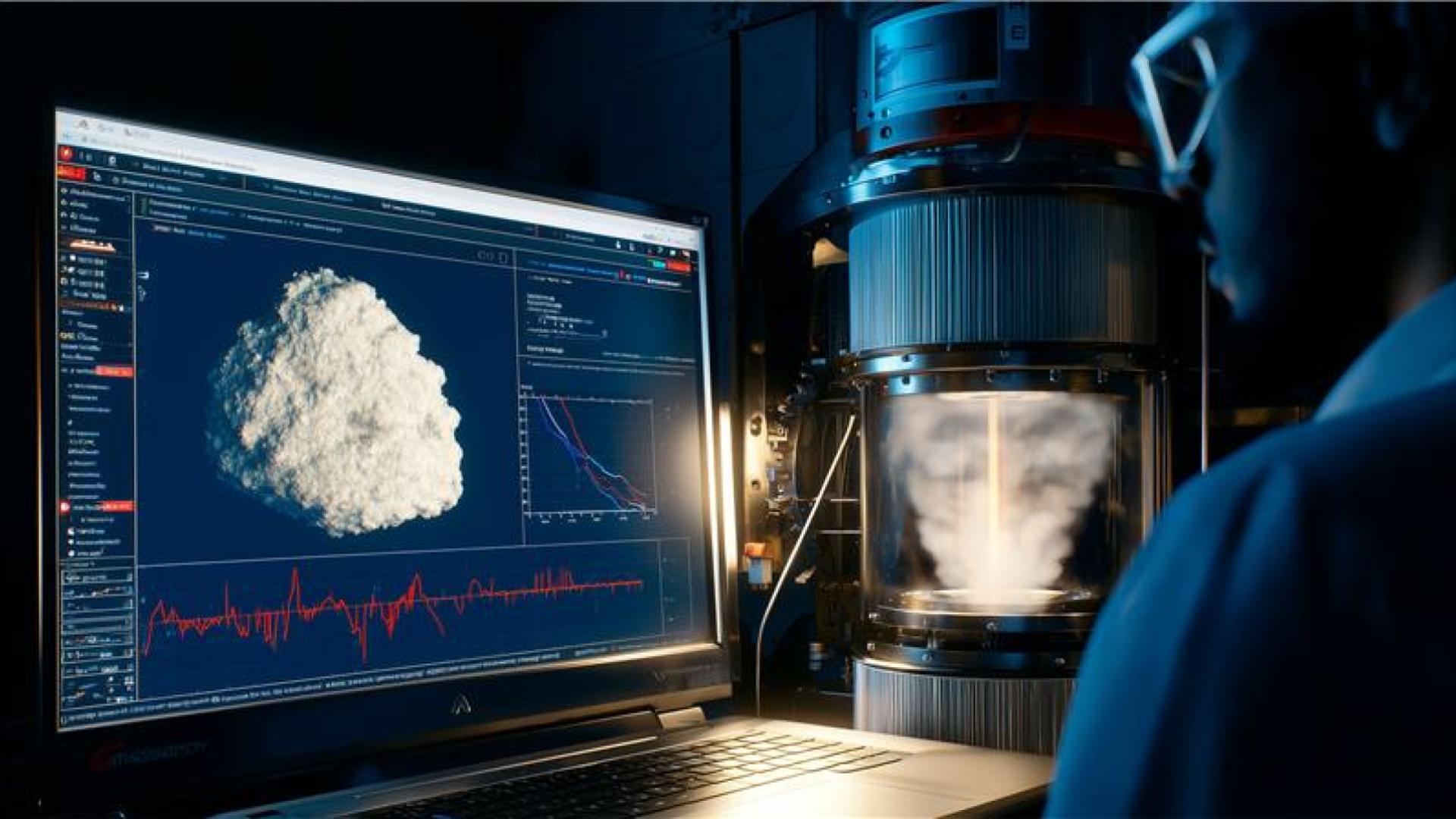
CalPhaD Coffee Lecture – From Heat Capacity to Gibbs Energy: Experimental Thermodynamics of High-Entropy Alloys
When
18 Nov 2026 13:00 - 14:00
Where
Online
Language
English
The CalPhaD Coffee Lecture is a discussion forum within the DGM Expert Committee on Thermodynamics. Invited speakers will present methods that may be unfamiliar to traditional CalPhaD experimentalists but hold potential for integration into established approaches.
In addition, the series will explore current challenges and emerging topics that provide fresh impulses for the CalPhaD community.
At this Coffee Lecture, Prof. Shmuel Hayun, Ben-Gurion University of the Negev, Israel, will give a presentation on: "From Heat Capacity to Gibbs Energy: Experimental Thermodynamics of High-Entropy Alloys".
Everyone interested is warmly invited to participate and contribute to the exchange.
Additional dates in the CalPhaD Coffee Lecture series are already scheduled, and registration is open. Explore the upcoming lectures and register for the sessions that interest you:
21.10.2026: Defect Phases in CALPHAD - From Bulk to Microstructure
16.12.2026: AI Agents in the CALPHAD Workflow: How Agentic Simulation Supports Alloy Design
20.01.2027: CALPHAD-Integrated Defect Thermodynamics
23.03.2027: Agentic Workflows for Accessible and Reproducible CALPHAD Simulations
Further information on the DGM Expert Committee on Thermodynamics.
Chair
Prof. Dr.-Ing. Stephanie Lippmann
Friedrich Schiller University Jena
Program
18 Nov 2026 (Wed)
PD Dr.-Ing. habil. Stephanie Lippmann
Friedrich Schiller University Jena
Understanding phase stability in complex alloys requires experimentally grounded thermodynamic data. In this lecture, I will present an experimental approach to derive temperature-dependent enthalpy, entropy, and Gibbs energy functions for single-phase high-entropy alloys, using the AlxCoCrFeNi system as a model. The approach combines heat-capacity measurements over a broad temperature range, high-temperature oxide-melt solution calorimetry for enthalpies of formation, physically based configurational entropy models, and comparisons with CALPHAD thermodynamic databases. Special attention will be given to challenges associated with metastable single-phase states, FCC/B2 ordering, magnetic contributions, and the use of experimental thermodynamics as a benchmark for database development. In the second part of the lecture, I will briefly introduce THERIS - the Thermal Research Institute of Israel at Ben-Gurion University of the Negev. THERIS was established to provide advanced capabilities for high-temperature materials characterization, including DSC/TGA, high-temperature calorimetry, oxide-melt solution calorimetry, dilatometry, thermal diffusivity and thermal conductivity measurements, controlled-atmosphere experiments, and characterization of ceramic and metallic materials under extreme conditions.
The lecture will show how integrated thermal analysis can transform measured heat-flow, heat-capacity, and calorimetric signals into thermodynamic insight. This connection among measurement, thermodynamic modeling, and materials design is essential for developing high-entropy alloys, ceramic materials, and other high-temperature materials for demanding technological applications.

Prof. Dr. Shmuel Hayun
Ben-Gurion University of the Negev, Israel
Prof. Dr.-Ing. Stephanie Lippmann
Friedrich Schiller University Jena