
Magnetic materials: Understanding materials from microstructure to application
Magnetic materials perform central functions in electric motors, generators, sensors, and other technical systems. Their properties are largely determined by material composition, microstructure, and manufacturing processes. The training course “Magnetic Materials for Renewable Energy and Mobility” offered by the German Society for Materials Science (DGM) will begin on 02 March 2027 in Pforzheim. It teaches the physical and materials science fundamentals and links them with manufacturing, characterization, quality assurance, and recycling. It takes place as part of Magnet Days 2027 and is aimed at specialists and managers from research, development, production, and industrial application.
Magnetic properties arise from material and microstructure
Permanent and soft-magnetic materials fulfill different technical functions and accordingly have different property profiles. For their targeted selection, an understanding of the physical fundamentals is therefore just as necessary as knowledge of the relationships between microstructure and magnetic behavior.
The training course “Magnetic Materials for Renewable Energy and Mobility” addresses these relationships systematically. It covers different types of magnets and their characteristic properties, as well as the question of how material structure and manufacturing conditions affect the achievable magnetic properties.
Manufacturing processes determine the property profile
Magnetic materials can be produced via different process routes. Depending on the material class and application, both the possible material states and the requirements for process control and quality assurance differ.
The training course covers synthesis and manufacturing processes for hard- and soft-magnetic materials and provides an overview of current developments. These include, among other things, sintered magnets, electrical steel sheets, and additively manufactured components. This makes clear how closely material development, manufacturing, and functional properties are interconnected.
Characterization, quality, and material selection
For the development and industrial use of magnetic materials, it is crucial to reliably capture microstructure and properties and correlate them with one another. Materials analysis and measurement technology therefore form an essential basis for material development and quality assurance.
Another focus of the training course is the analysis of magnetic materials as well as the evaluation and assurance of their quality. Participants examine which properties are relevant for different applications and how suitable magnetic materials can be selected on this basis.
Considering raw material availability and recycling
Especially for permanent magnets, a purely functional material assessment is increasingly no longer sufficient. Raw material demand, availability, and options for circularity influence material development and industrial use just as much as the achievable technical properties.
The training course therefore also addresses market developments, raw material demand, and approaches to recycling and sustainability. In this way, magnetic materials are considered not only in terms of their function, but within a broader context of manufacturing, application, quality, and circularity.
Training course as part of Magnet Days 2027
The training course is part of Magnet Days 2027, which will take place from 02 to 04 March 2027 at Pforzheim University. The conference brings together research, industry, and academia on topics related to permanent magnets. The focus includes new magnetic materials, microstructure and magnetism, manufacturing, characterization, applications, and recycling.
The combination of training course and scientific conference thus creates the opportunity to connect a fundamental understanding of materials with current questions from research and industrial practice.
Training course at a glance
Date: 02 to 03 March 2027
Venue: Pforzheim University
Language: German
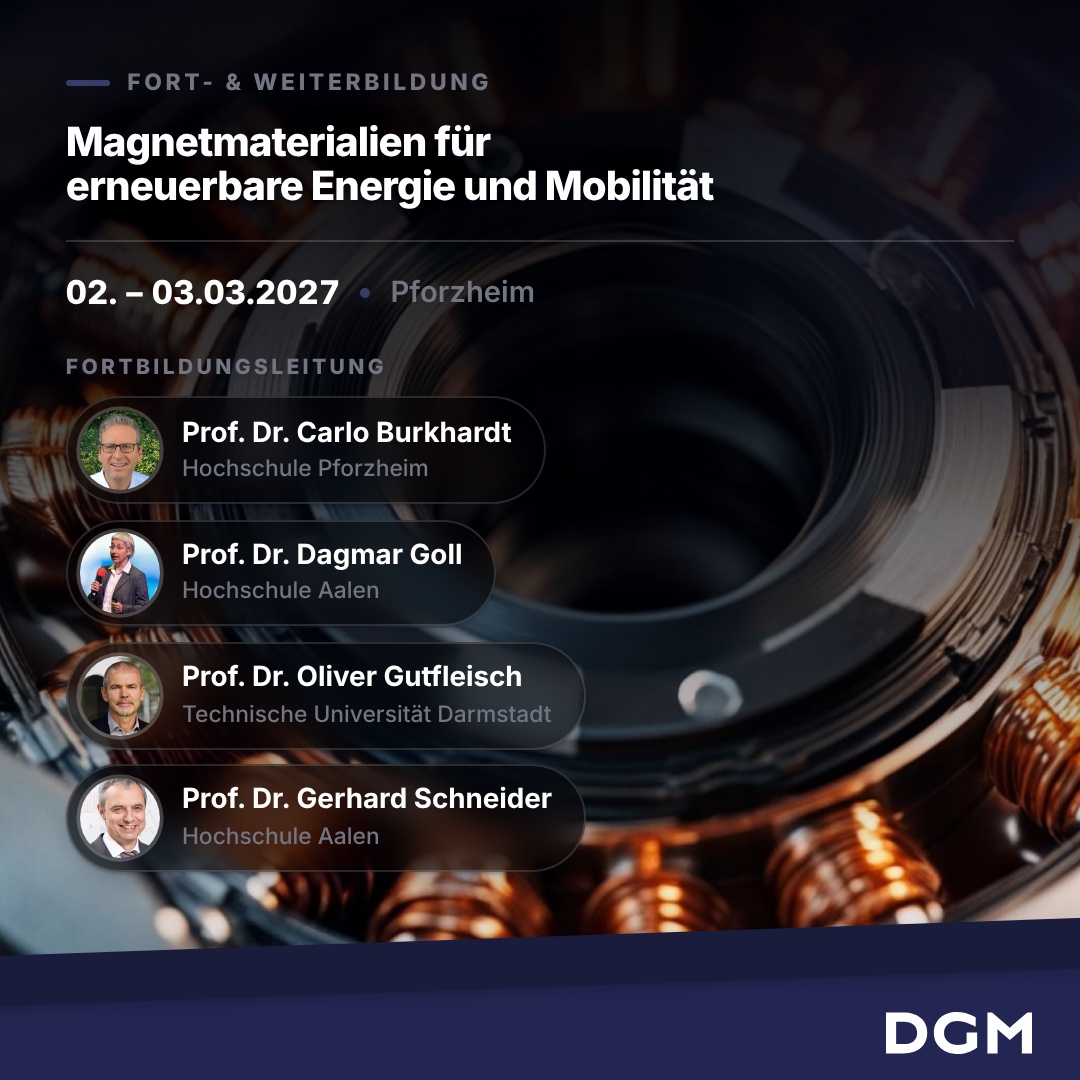
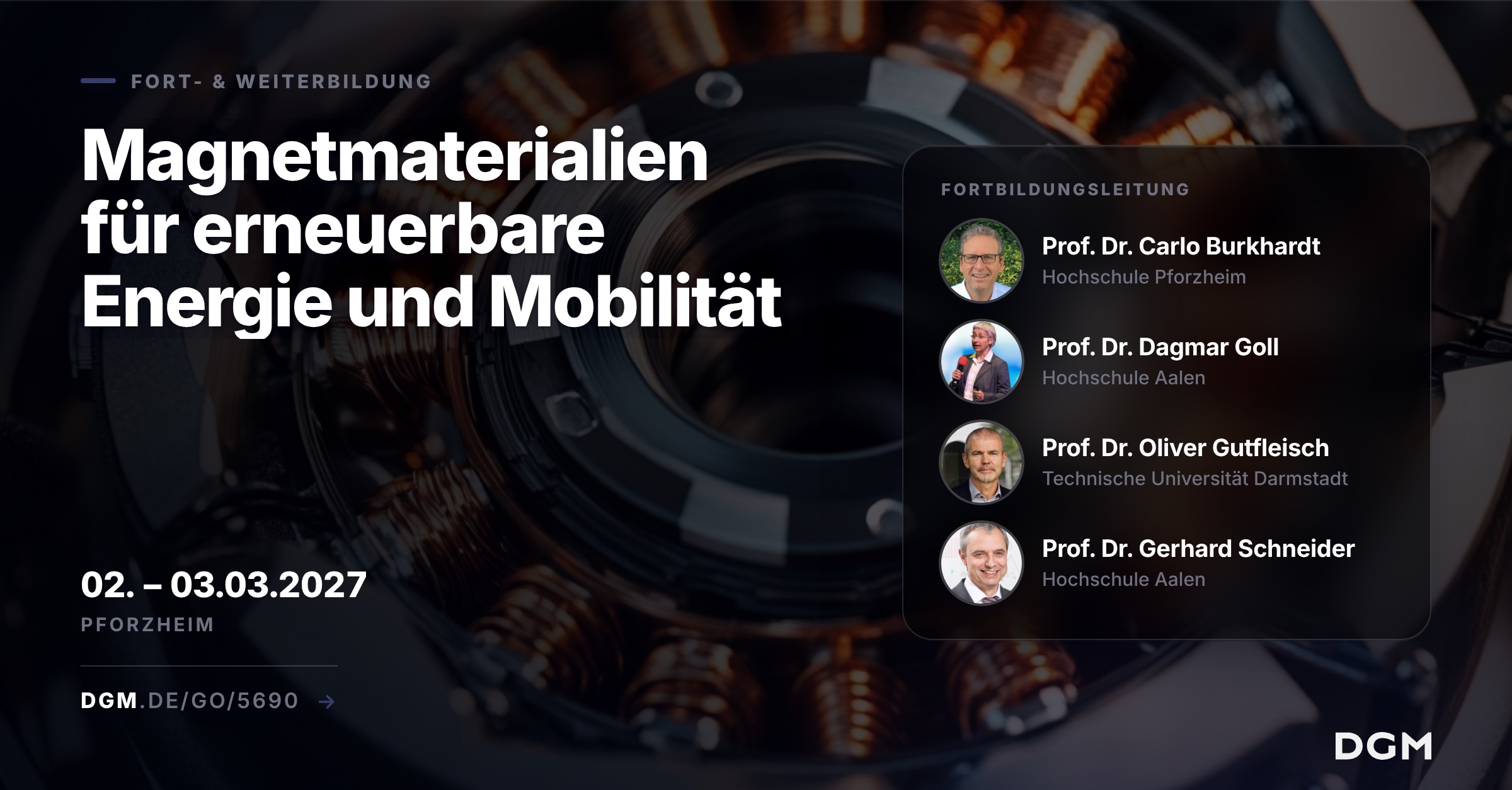
Training Course Chairs: Prof. Dr. Carlo Burkhardt, Pforzheim University; Prof. Dr. Dagmar Goll, Aalen University; Prof. Dr. Oliver Gutfleisch, Technical University of Darmstadt; Prof. Dr. Gerhard Schneider, Aalen University
Organizer: DGM Academy
Further information on content, program, and participation is available on the Magnet Days 2027 website.