
Fractography of Metallic Materials: Systematically Analyze Fracture Surfaces and Classify Causes of Failure
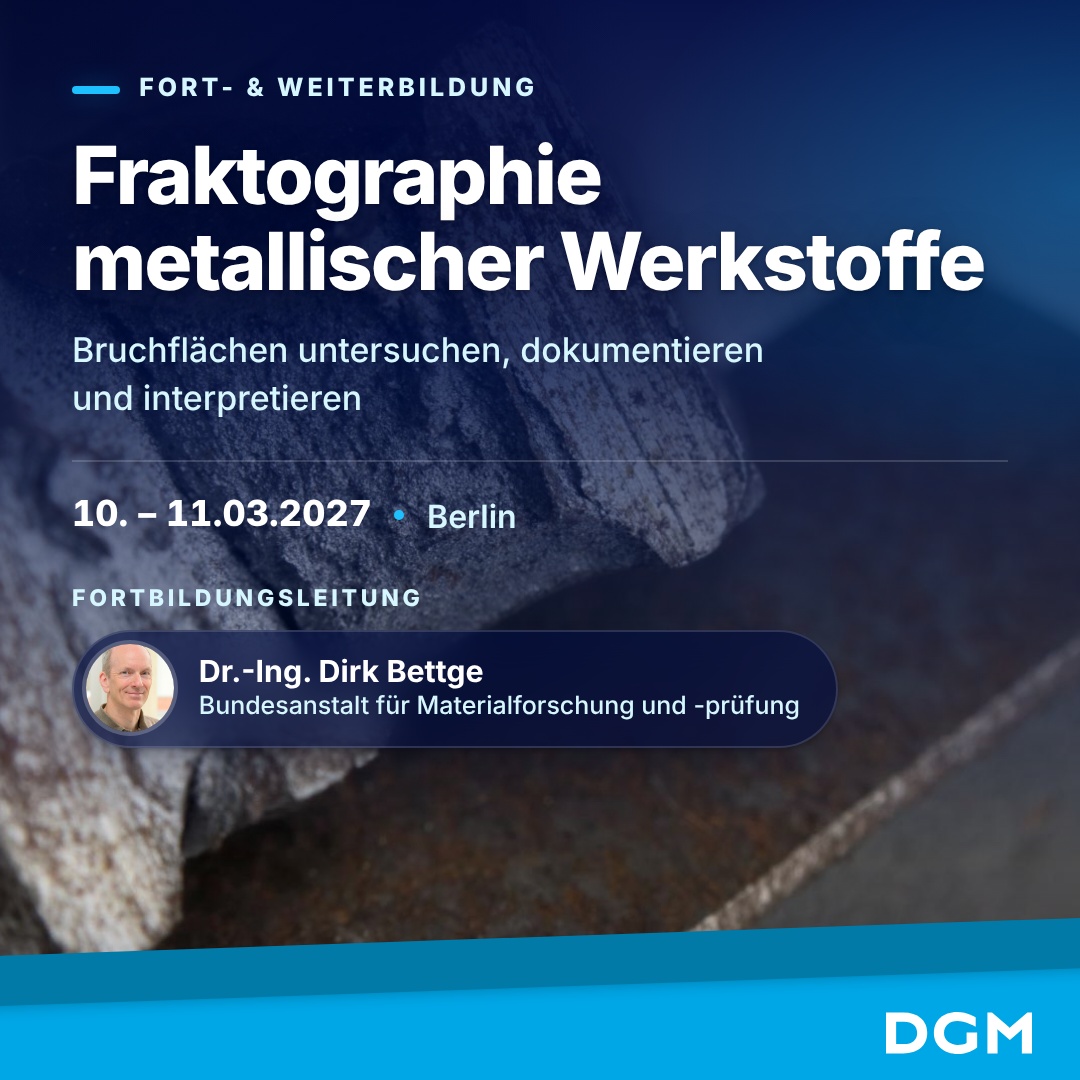
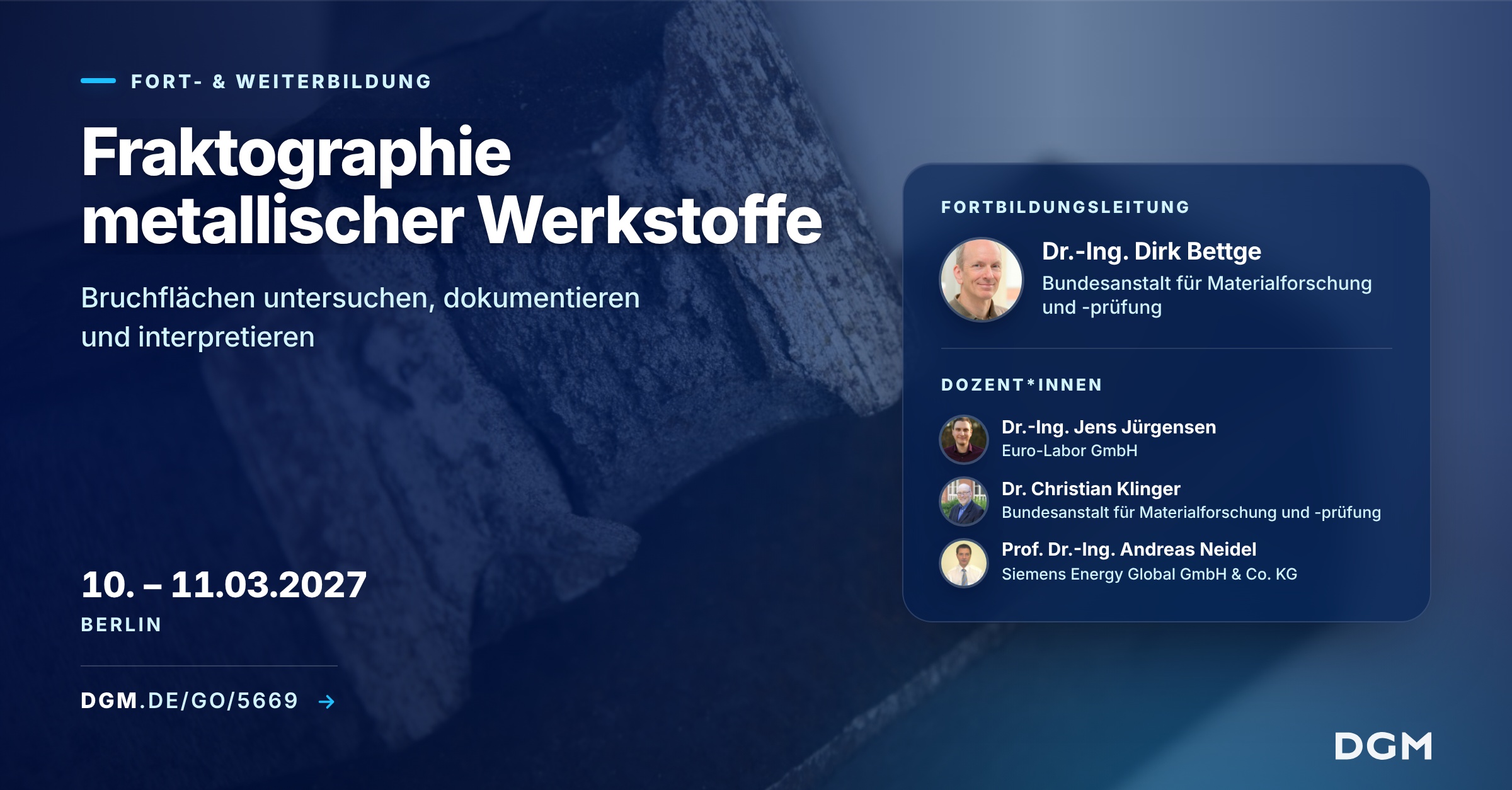
Fracture surfaces contain essential information about the mechanisms that led to the failure of metallic components. However, their proper examination requires more than identifying individual features. What matters is systematic documentation, suitable microscopic methods, and a reliable classification of the findings. The German Society for Materials Science (DGM) training course “Fractography of Metallic Materials” will teach practice-oriented methods for materials testing, quality assurance, and component investigation from 10 to 11 March 2027 in Berlin.
Fracture Surfaces as a Source of Information for Damage Assessment
When examining a failed component, the fracture surface is one of the most important sources of information available. Macroscopic and microscopic features can provide indications of how a crack propagated, what stresses were present, and which mechanisms contributed to the failure.
However, interpretation is demanding. Artifacts can be confused with actual fracture features, while prematurely assigning individual structures to a specific failure mechanism can lead to incorrect conclusions. A systematic approach to examination and documentation is therefore an essential prerequisite for comprehensible assessments.
From Macroscopic Examination to Scanning Electron Microscopy
The “Fractography of Metallic Materials” training course combines methodological fundamentals with the practical examination of real components and specimens.
Key topics include:
- characteristic fracture mechanisms of metallic materials
- macroscopic and microscopic fracture features
- fatigue fractures and indications of cyclic loading
- hydrogen-induced fractures
- photography and light microscopy
- scanning electron microscopy
- preparation and structured image documentation
Participants record and interpret fracture features using concrete examples. This not only trains the recognition of typical structures, but above all their classification in the context of material, loading, and component failure.
Digital Tools for Structured Findings
In addition to conventional examination methods, the training course covers digital tools for fractographic work.
The online database FractoDB enables fracture features to be compared systematically. FractoGraphics also provides a symbol system that allows fractographic findings to be documented in a structured and comprehensible way.
Such comprehensible documentation is particularly relevant for materials testing, quality assurance, and failure analysis. It facilitates professional communication of findings and supports the comparability of different examinations.
Relevance for Industrial Testing and Decision-Making Processes
Errors in interpreting fracture surfaces can have practical consequences. Repeated testing, unsuitable corrective actions, or delayed decisions create additional effort and can increase quality risks.
Reliable fractographic analysis therefore helps to distinguish more clearly between observation and interpretation and to use findings more specifically for technical decisions. This includes questions of material selection, component testing, quality assurance, and damage prevention.
The training course is aimed in particular at specialists who already work in materials testing, quality assurance, or component investigation and want to deepen their practical competence in the analysis of metallic fracture surfaces.
Training Course at a Glance
- Date: 10 to 11 March 2027
- Venue: Berlin
- Language: German
- Training course Chair: Dr.-Ing. Dirk Bettge, Federal Institute for Materials Research and Testing
- Certificate: upon participation
- Organizer: DGM Academy
With its training and professional development programs, the German Society for Materials Science (DGM) addresses methodological and application-oriented issues from materials science and engineering and brings together scientific fundamentals with requirements from testing and industrial practice.