
Integrity and Service Life of Cracked Components: New DGM Training Course Combines Fracture Mechanics, FEM and Codes and Standards
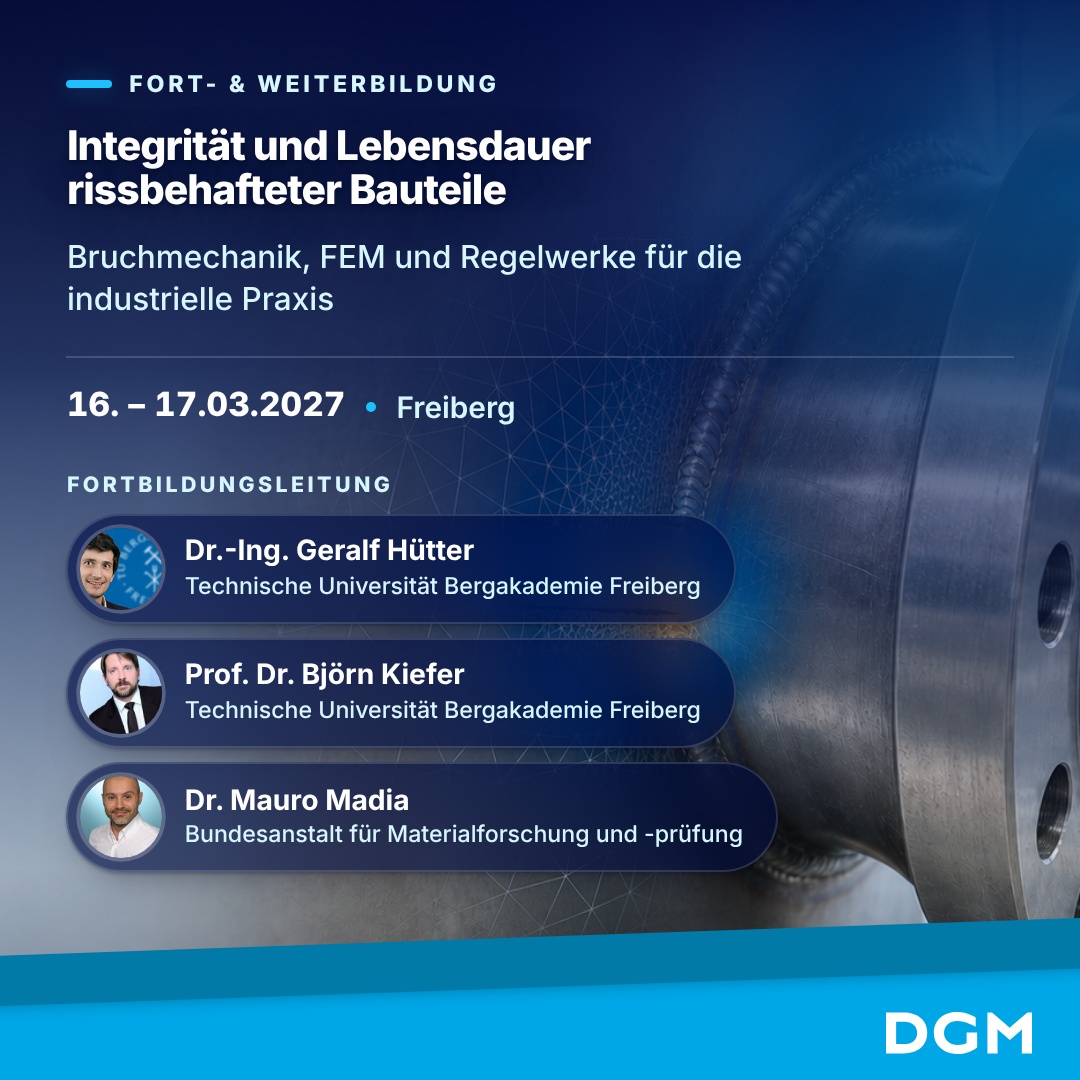
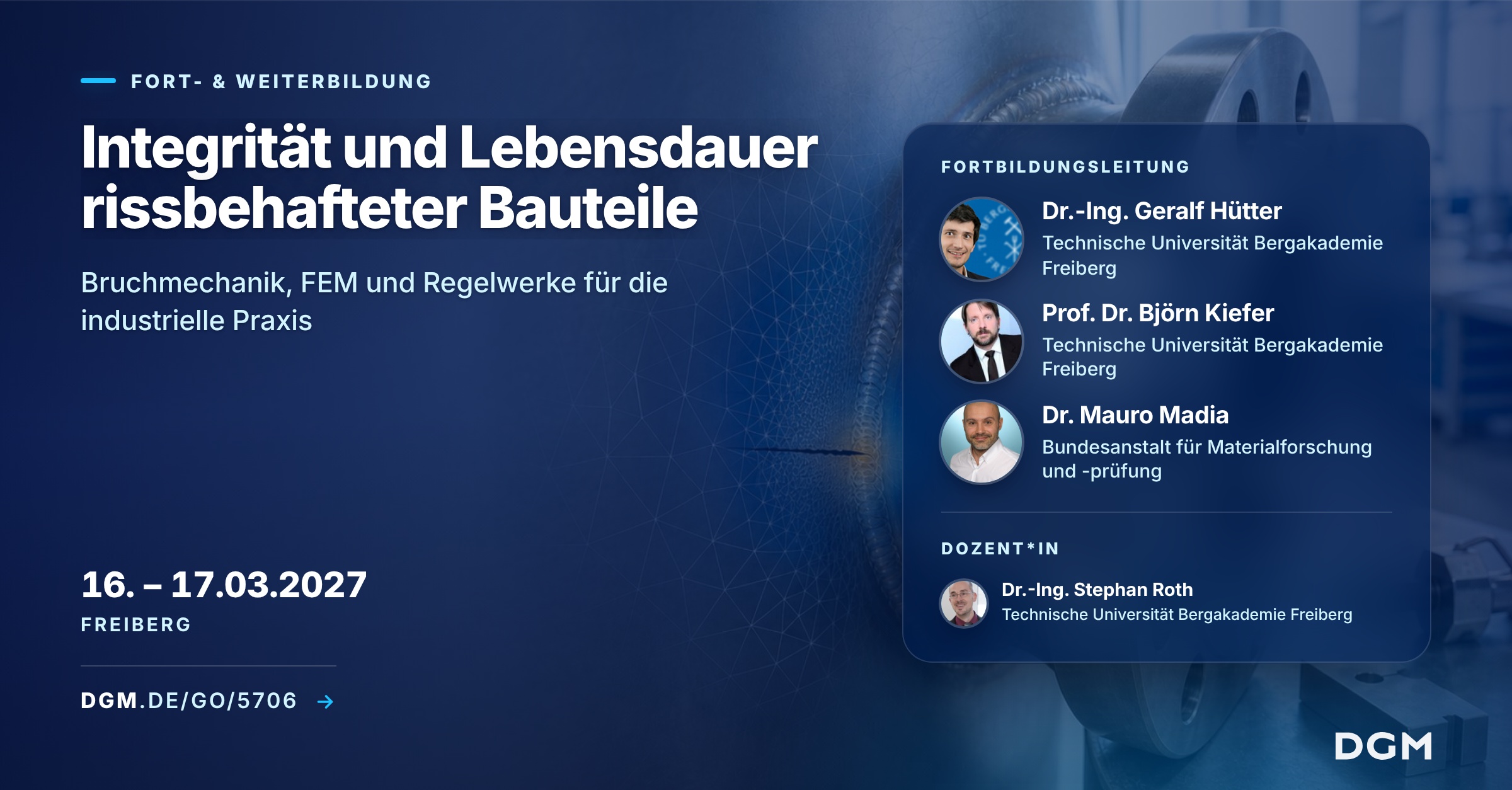
When is continued operation of a cracked component technically justifiable, and when are repair or replacement required? The new training course offered by the DGM Academy on 16 and 17 March 2027 in Freiberg teaches methods for the systematic assessment of component integrity and remaining service life. The focus is on fracture-mechanics concepts, numerical crack analyses using the finite element method (FEM), and the application of established codes and standards. The program is aimed in particular at specialists in design, calculation, materials engineering, testing, and industrial maintenance.
Detecting and assessing cracks and securing technical decisions
Cracks in mechanically loaded components present design, operation, and maintenance with challenging decisions. Not every detected crack requires immediate replacement. The decisive question is whether the integrity of the component can be sufficiently demonstrated under the existing loading conditions and how an existing crack will develop during further operation.
For this purpose, material properties, crack geometry, loading conditions, and possible damage mechanisms must be considered together. Incorrect assumptions or unsuitable assessment methods can lead to risks being underestimated or components being replaced prematurely.
The DGM addresses these questions with the new training course “Integrity and Service Life of Cracked Components: Fracture Mechanics, FEM, and Codes and Standards for Industrial Practice”.
From fracture-mechanics parameters to numerical crack analysis
The two-day training course covers both linear-elastic and elastic-plastic fracture mechanics. Participants learn how to select suitable assessment concepts depending on material behavior, crack geometry, and the respective load case.
The technical focus areas include stress intensity factors, J-integral and CTOD, as well as the calculation of fatigue crack growth under cyclic loading. These methods form an essential basis for assessing failure limits and estimating remaining operating times.
Another focus is the numerical investigation of cracked components using the finite element method. Practical exercises with Ansys or Abaqus cover crack modeling, the calculation of relevant parameters, and the critical interpretation of simulation results.
Codes and standards for traceable integrity assessments
In addition to the computational fundamentals, the application of established assessment procedures is a central focus. These include the FKM Guideline, BS 7910, R6, and SINTAP.
The training course shows how these approaches can be used for specific technical questions and which requirements and limits of application must be observed. Practice-oriented examples illustrate typical sources of error when selecting material properties, performing FEM modeling, and assessing crack growth.
The aim is to structure fracture-mechanics assessments systematically and to classify results in such a way that decisions on continued operation, repair, or replacement can be made on a sound technical basis. This is particularly important for safety-relevant and cost-intensive components, where both undetected damage progression and unnecessary replacement can have significant consequences.
Academic coordination and participation
The training course is academically supported, among others, by Dr.-Ing. Geralf Hütter and Prof. Dr. Björn Kiefer from Technische Universität Bergakademie Freiberg, as well as Dr. Mauro Madia from the Federal Institute for Materials Research and Testing.
It is aimed at engineers and technical specialists from research and development (R&D), design, simulation, materials testing, quality assurance, and maintenance. In addition to the theoretical fundamentals, practical case studies offer an opportunity to discuss participants’ own questions with the experts.
Event information
- Date: 16 and 17 March 2027
- Venue: Freiberg
- Language: German
- Certificate: after participation
- Organizer: DGM Academy