![[Translate to English:]](/fileadmin/_processed_/a/3/csm_DGM-Logo-Buchstaben-blau_cf0fc5a057.png)
![[Translate to English:]](/fileadmin/DGM/DGM/Logo/DGM-Logo-Buchstaben-blau.png)
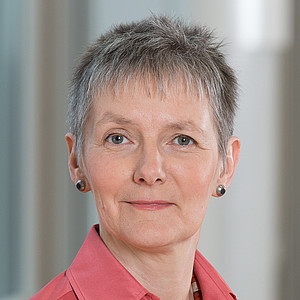
Birgit Skrotzki, who heads the Department of Experimental and Model-Based Materials Mechanics at BAM, will take up her post, which she shares with Prof. Dr. Martin Heilmaier from the Karlsruhe Institute of Technology, in January 2023.
The DGM is an association rich in tradition with a history of over 100 years. What are the challenges for materials science and materials engineering at the beginning of the 21st century?
We have to become more sustainable. This includes the recycling of materials at the end of the product life cycle, e.g. of mobile electronic devices such as smartphones, of cars or even the rotor blades of wind turbines. In general, we need to make the best possible use of raw materials and resources, especially since many of them are in short supply, including, incidentally, energy, as we are currently painfully experiencing. In the future, we should consider the availability of critical raw materials and the recyclability of materials and products much more strongly and already in the material development process. The DGM is already taking up these topics today, for example with the Circular Materials Expert Committee, which will be founded in 2021.
What can materials science contribute to major societal tasks such as the transformation to climate neutrality?
Materials science is an important key to the development of modern technologies, which we urgently need to solve the major, societal tasks of the future. Think, for example, of the electric mobility megatrend: For this we need new, improved battery materials. And also lightweight materials. For example, in the form of light metals and composites that have high strength and at the same time low density, so that they can compensate for the high weight of batteries. This allows us to save precious energy needed for locomotion. There are also material problems to be solved in the generation of energy from renewable sources such as wind or solar power. Here, it's not just a question of new materials, but also of extending the service life of the plants - which brings us back to the issue of sustainability. And finally, the increased use of hydrogen places new demands on materials that need to be investigated and evaluated.
You yourself are involved in the MaterialDigital platform, which, in addition to BAM, brings together leading scientific institutions in the field. What are the concrete benefits of digitization for materials science?
Our fundamental goal is to make materials data available in an optimally documented form in as large a quantity as possible and easily accessible so that they can be used quickly and effectively in new digital laboratory and industrial processes. This covers the entire life cycle of a material or component, including the process chain. In order to move away from the isolated solutions that predominantly exist at present, data room concepts are being developed in various current research initiatives that enable data exchange while still ensuring the data sovereignty of those involved. In the future, this will certainly lead to an acceleration of material development, a reduction in development costs, better material utilization and higher usability of components.
Is there a topic that is particularly important to you for your presidency?
In addition to the strategic further development of the DGM, the promotion of young talent is an important concern for me. On the one hand, the DGM must remain attractive to young scientists and perhaps become even more attractive, and on the other hand, young members should be offered even more opportunities to participate. The topic of women in science is also very important to me. My colleague and current DGM President Prof. Martina Zimmermann has been committed to advancing this topic during her term in office. I would like to continue this and set further accents here. The materials sciences are - fortunately - no longer a male domain. They offer women interested in technology excellent prospects for the future and the chance to help solve really important questions about the future.
What is the current focus of your own materials science research at BAM?
In addition to digitalization topics, I am conducting application-oriented research with my team on the mechanical behavior of metallic high-temperature materials. We are currently starting a project involving a modified steel which is to be used in hydrogen-powered turbines for energy generation. The aim here is to investigate many material properties in order to make the turbines fit for hydrogen.
The interview was publisehd on 26th October 2022 at the BAM's homepage.