![[Translate to English:]](/fileadmin/_processed_/a/3/csm_DGM-Logo-Buchstaben-blau_cf0fc5a057.png)
High-Temperature Experiments and Nanoindentation: Current Research Approaches
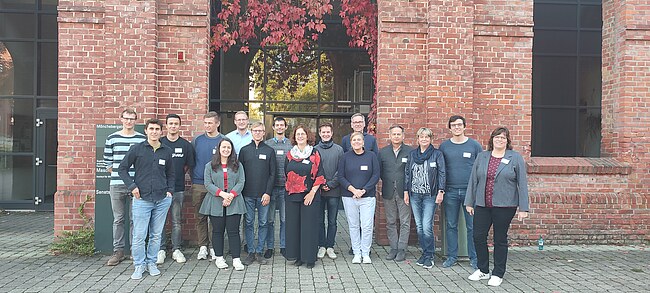
The meeting was opened by the head of the working group, Dr. Anja Weidner, who warmly welcomed the participants. Prof. Thomas Niendorf, host and head of the department "Metallic Materials", welcomed the participants and emphasized the importance of in-situ characterization for modern materials research.
The agenda included a variety of exciting topics. Dipl.-Ing. Moritz Müller from the Institute of Materials Engineering at TU Bergakademie Freiberg presented high-temperature in-situ experiments on steel-ceramic composites, followed by Dr. Florian Schäfer from the University of Saarbrücken, who spoke about in-situ nanoindentation in liquids. Dr. Anja Weidner also presented the results of her PhD student Gökhan Günay, who was unfortunately unable to attend, on in situ nanoindentation in the scanning electron microscope on refractory composites.
Precision in Biomechanics
A special highlight was the lecture of Dipl.-Math. Dagmar Nestler from Chemnitzer Werkzeugmechanik GmbH about the Digital Volume Correlation (DVC) software VEDDAC volume, which was used to characterize the biomechanical properties of bones and 3D printed bone replacement materials.
Shape Memory Alloys and Innovative Characterization Methods
Dr. Christian Lauhoff from the University of Kassel presented innovative approaches for in situ characterization of high temperature shape memory alloys using optical microscopy, neutron and synchrotron radiation. In addition, Anja Weidner presented the in situ characterization of Ni-Ti shape memory alloys using digital image correlation (DIC), thermography and acoustic emission.
Machine Learning and Crack Initiation: New Ways to Analyze Materials
Prof. Thomas Kordisch from the Bielefeld University of Applied Sciences and Arts provided insights into the analysis of crack initiation using in-situ bending tests and the challenges involved, while Alexander Delp from the TU Dortmund University shed light on the in-situ characterization of mechanically induced damage in materials using SEM and CT with machine learning methods.
Another practical part of the session was the information and equipment demonstration by Prof. Thomas Niendorf on real-time process monitoring in laser cladding.
Laboratory Tour and Outlook on the Next Meeting
The meeting concluded with a laboratory tour of the Institute of Materials Technology Kassel, where participants had the opportunity to see the latest technologies and methods on site.
The 11th meeting of the "In situ 2D and 3D Characterization" working group provided an excellent platform for the exchange of knowledge and ideas that will shape the future of materials research. Thanks to the support of DGM, the event was offered in a hybrid format, allowing participants to follow the presentations online.
Many thanks to the host - the IfW Kassel - for the excellent organization.
For further information, please contact PD Dr.-Ing. habil. Anja Weidner at the e-mail address weidnerww.tu-freiberg.de or by phone at +49 3731 2124.
Information on all expert committees can be found on the DGM homepage at https://dgm.de/en/network.
If you are interested in becoming an active member of one of the committees, please send a short e-mail to fachgremiendgm.de.