
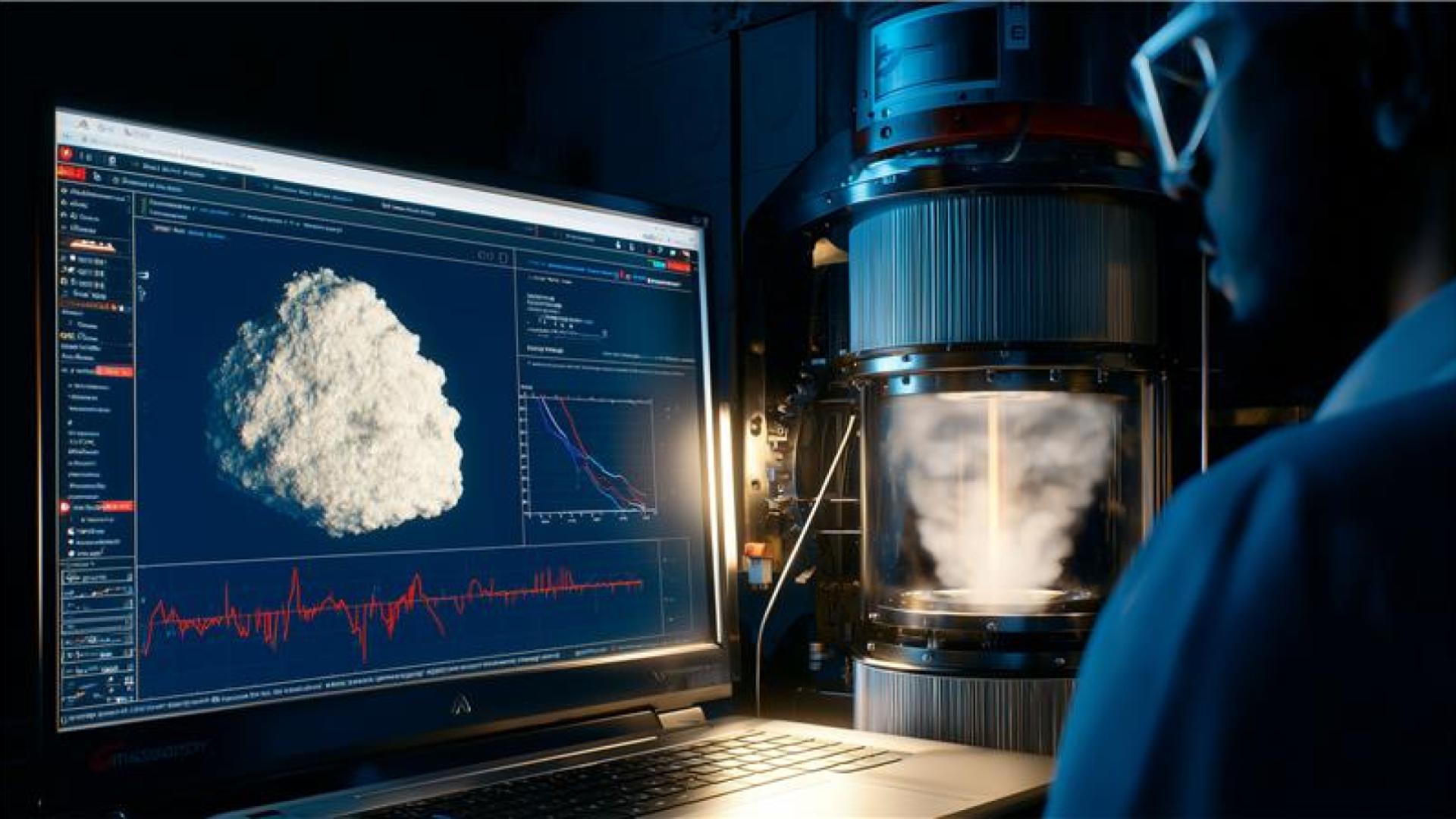
CalPhaD Coffee Lecture – Property measurement with electromagnetic levitation: density, latent heat, surface tension
Wann
03.09.2025 13:00 - 14:00
Wo
Online
Sprache
Englisch
The CalPhaD Coffee Lecture is a new discussion forum within the DGM Expert Committee on Thermodynamics. Invited speakers will present methods that may be unfamiliar to traditional CalPhaD experimentalists but hold potential for integration into established approaches.
In addition, the series will explore current challenges and emerging topics that provide fresh impulses for the CalPhaD community.
At this Coffee Lecture, Prof. Dr. Jürgen Brillo, German Aerospace Center DLR, will give a presentation on: "Property measurement with electromagnetic levitation: density, latent heat, surface tension".
Everyone interested is warmly invited to participate and contribute to the exchange.
Further Coffee Lectures:
- 29 October 2025: Development of Thermodynamic Database for Clean Manufacturing of Steels and Alloys
- 12 November 2025: Exploration of fast time scales in metallic glasses and reactive metallic multilayers by chip calorimetry
- 10 December 2025: Augmented tracer-interdiffusion couple method: a high-throughput approach for consistent measurements of the tracer diffusion coefficients
Further information on the DGM Expert Committee on Thermodynamics.
Leitung

Prof. Dr.-Ing. Stephanie Lippmann
Friedrich-Schiller-Universität Jena
Programm
03.09.2025 (Mittwoch)
PD Dr.-Ing. habil. Stephanie Lippmann
Friedrich-Schiller-Universität Jena
Al-Ti-V alloys play an important role in technical applications. Especially, the liquid phase and its properties are of tremendous importance, as the vast majority of materials is directly made by casting. In order to understand and model those thermophysical properties, and in order to be able to optimize a material, systematic composition dependent measurements are mandatory. However, despite the importance of Al-Ti-V alloys, data is sparse for the binary and ternary systems. One reason for the lack of data is the increased chemical reactivity of liquid Ti at high temperatures. Containerless investigation methods, such as electromagnetic levitation, are therefore inevitable.
The present talk presents data on density, surface tension, and molar heat capacity for binary Al-Ti, Al-V, Ti-V and ternary Al-Ti-V alloys. For each alloy system, the composition is systematically varied and thermodynamic mixing rules based on the (sub-)regular solution model are discussed.
It is found that Al-Ti and Al-V are highly non-ideal systems with strongly negative excess volumes and positive excess surface tensions. In contrast to this, Ti-V can be approximated by the ideal solution model. The properties of the ternary alloy system are dominated by the Al-Ti subsystem. Mathematically, a large ternary parameter has to be included into the Redlich-Kister equation in order to compensate for the effect that Al-V, should have on the excess properties if binary interactions are considered alone.
Molar specific heat is discussed for liquid Ti and two Al-Ti alloys with different composition. The data as function of temperature has a positive- or negative slope, depending on the alloy system. The molar specific heat data exhibits a positive deviation from the Neumann-Kopp rule which is consistent with the negative excess Gibbs energy of Al-Ti. The finding shows that the linear approximation of the temperature dependence of the Redlich-Kister interaction parameters is oversimplified for the calculation of the molar heat capacity.
In addition, the effect of oxygen on the surface tension is studied in detail for liquid Ti and V. Due to the highly attractive interaction between Oxygen and Titanium or Vanadium, respectively, oxygen is preferable coordinated in the bulk. The is surface virtually clean over a broad range of oxygen concentration until the latter is increased above the critical value of 1 at.-%. As a result, surface tension data is almost unaffected by the presence of oxygen in Titanium or Vanadium, as long as the quantities of oxygen remain moderate. For oxygen mole fractions larger than 1 at.-%, the surface tension decreases linearly on the logarithmic scale.

Jürgen Brillo
Institute of Frontier Materials on Earth and in Space, German Aerospace Center (DLR)

H. Fukuyama
Institute of Multidisciplinary Research for Advanced Materials (IMRAM), Tohoku University
H. Kobatake
Department of Environmental Systems Science, Doshisha University
S. Ozawa
Department of Advanced Materials Science and Engineering, Chiba Institute of Technology
Yuriy Plevachuk
Department of Metal Physics, Ivan Franko National University of Lviv
B. Reiplinger
Institute of Frontier Materials on Earth and in Space, German Aerospace Center (DLR)
K. Saito
School of Materials and Chemical Technology, Tokyo Institute of Technology
Y. Seimiya
Department of Advanced Materials Science and Engineering, Chiba Institute of Technology
J. Wessing
European Space Research and Technology Centre
PD Dr.-Ing. habil. Stephanie Lippmann
Friedrich-Schiller-Universität Jena